
4 min read
You understand German but cannot speak? The trick that makes speaking German much easier
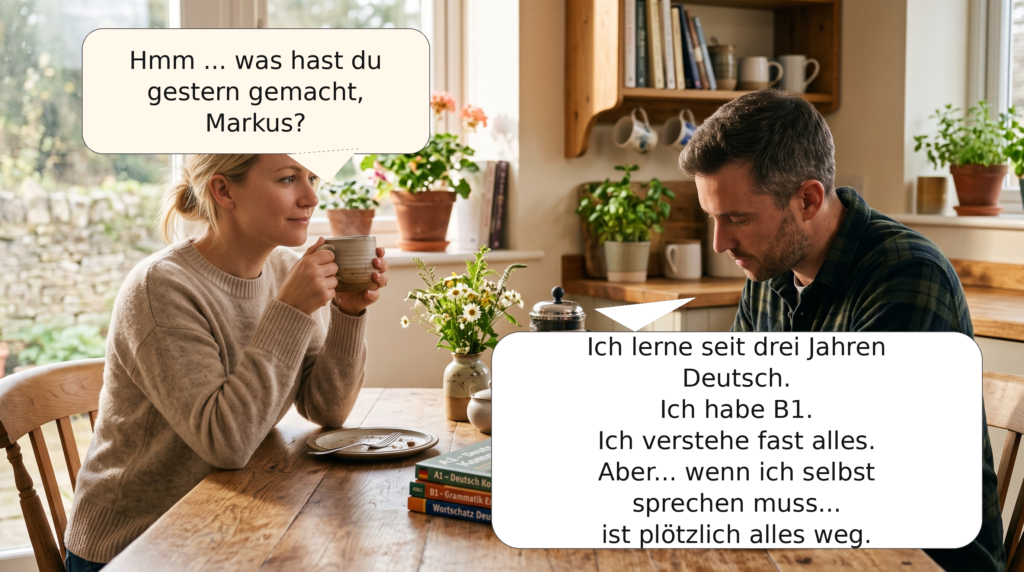
When Speaking Is Harder Than Comprehending
A real German B1 moment: You already understand German pretty well. Movies, podcasts and conversations are no longer a problem.
As soon as you have to speak German yourself you suddenly cannot find the right words?
You are not alone, in this. Many German learners face this problem.
In this video, Markus takes on a 30-day challenge. He tries out a simple method for speaking German more fluently—without spending hours memorizing vocabulary or cramming grammar.
What you’ll learn here:
Why many people understand German but can’t speak it.
- How to respond more quickly in German.
- How to practice speaking German on your own.
- Why active practice is more important than learning even more vocabulary.
- How a simple 30-day method can help you.
Watch the video
Many people ask themselves, “Why can I understand German but not speak it?”
Markus explores exactly this question in his 30-Day Challenge. Step by step, you’ll discover why speaking is often harder than understanding—and what method helped him speak German with more confidence and fluency.
This video is just the beginning.
Want to try out the method for yourself? Download the free 30-Day German Journal and start your own challenge today.
Why you can understand German but not speak it?
Many German learners are familiar with this feeling. They do understand conversations, videos or podcasts in German quite well but as soon as they want to speak themselves, the words suddenly elude them.
The reason is simple. Understanding and speaking are two skills. When listening learners’ brain recognizes words and sentences. When speaking however one has to find and use words themselves within seconds. That is exactly what requires active practice.
That is why it is often not enough to learn new vocabulary or review grammar. If German learners want to speak German they have to use the language regularly, for example by writing, speaking out loud or doing small daily exercises.
That is what this video is about. Markus tries out a 30‑day method and shows how regular active practice can help him speak German more easily and fluently.
Why do I understand German but can’t speak it well?
Many German learners have no trouble understanding conversations or videos. When speaking, however, the brain has to retrieve words quickly and use them actively. That is why speaking German is often more difficult than understanding it.
How can I practice speaking German on my own?
Even without a language partner, you can still improve your spoken German. Writing regularly, speaking aloud, and doing exercises with the help of AI can help you actively use the language..
Can AI tools like ChatGPT, Gemini, Claude, etc., help improve one’s German language skills?
Sure. AI can help you with writing, proofreading, and practicing. When used correctly, it can be a useful addition to your German study routine.
How can I think faster in German?
This usually doesn’t happen overnight. With regular, active language practice, many learners find it increasingly easy to formulate their thoughts directly in German.
What does really help with speaking German?
The most important step is to actively use German on a regular basis. Just learning vocabulary is often not enough. If you start speaking and thinking in German every day you’ll improve your German much faster in the long run. The key is to use German language on a regular basis. Even a few minutes a day can make a big difference, over time.